
Rediscovering lost songs on an old hard drive
I blew the dust off an old hard drive and plugged it into my laptop. I was looking for an old logo design a client had asked me to find, but what caught my eye was my abandoned attempt to be a singer-songwriter, in the form of a folder labelled ‘song recordings’.
It might be 26 years since I wrote a song. Although honestly, I have no sense of time, so maybe it’s safer to just say it’s been a while, long enough that I was sure any recordings that might have once existed were long lost.
I opened the folder, wondering what I would find, and what I would make of the songs after all this time.
The folder contained five files.
As I double clicked each file, I found it harder to be impartial about the music than I expected, the nostalgia was too overpowering. A strange window into a past life, a moment in time captured in a rough yet fragile auditory landscape made up of dark thoughts, naive love, and emotional fatigue.
One reason I gave up writing songs was the frustration at my inability to untangle what was in my head and weave it into words and music – but now, listening back, I caught ear-glimpses of evidence that I wasn’t quite as incompetent at it as I thought.
Sure, the recordings were terrible quality, but I couldn’t help wondering what they might have sounded like if I hadn’t given up. I wondered what they would sound like if they were fully produced.
‘I guess I’ll never know’, I thought, and I closed the laptop.
The songs that would not stay buried
Over the next few weeks I would find snippets of the lyrics bubbling up to the surface, or I would find myself mentally singing snatches of the songs.
The ‘what if’ questions continued to haunt me.
I wondered what kind of life the songs could have had.
I only ever knew how to bash them out on an acoustic guitar, but I felt like they could be more, if only I’d had the skills or had sought out collaborators. I imagined the songs with instrumentation, layers, harmonies, electronic beats, and glitchy lo-fi influences.
I had, at some point, tried to teach myself electronic music production, but I never developed the skills needed to produce finished tracks.
And then it hit me.
Discovering Suno (AI music) as a creative second chance
Suno, the AI music generator, has a ‘Covers’ feature. You can upload a track and Suno will preserve the lyrics and melody but let you prompt for different musical styles.
I uploaded one of my tracks, Suno analysed my recording and created a prompt for me. Based on the recording Suno decided this was a folk ballad.
The song Suno generated sounded like an accomplished country and western act had recorded my song. It was polished and impressive sounding, and gave me a new lease of confidence in the song.
It was also at least a million miles away from how I personally envisaged the finished song.
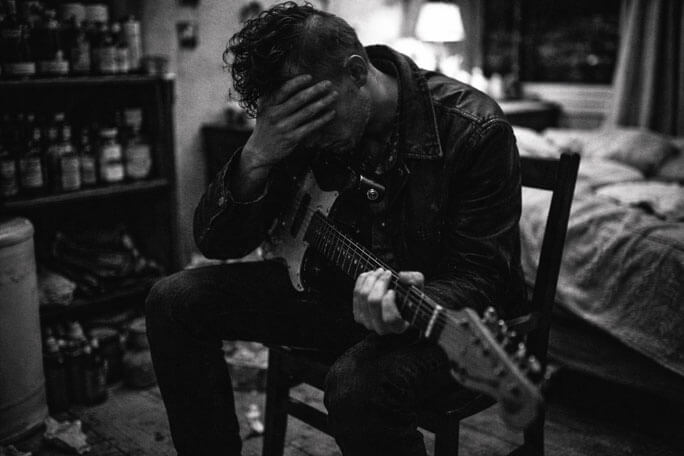
Prompting, iteration, and finding the right sound
So I got to work on developing prompts that would achieve the electronic sound I was looking for, a kind of atmospheric electronic alt-folk with glitchy influences. I knew roughly what I wanted, but not precisely, and I accepted that I would have to feel my way towards it rather than design it in advance.
I worked with ChatGPT to develop prompts, and then tested them in Suno, tweaking them, adding phrases, removing elements, doing multiple generations, and tweaking the settings looking for the right sound.
Finally I generated a track that had the sound I was looking for. Having found the sound, I was able to ‘save’ it with another great Suno feature called ‘Personas’ that allows you to apply that style to new generations.
The Persona feature definitely makes things easier, but it wasn’t as simple as applying the persona to my other tracks and being done. For one track I knew I wanted the same general style, but that it needed a string section. I knew what I was looking for, but I just wasn’t quite getting it.
Working with AI is a weird mix of the technical and pure randomness. I was making conscious creative choices and guiding the process, but precise control just isn’t possible. I ended up generating 80 versions before I was happy with the title track see me fall, and in the end I honestly couldn’t tell you what had more influence – my crafted input or pure chance.
Is AI creativity really so different from human creativity?
Like any generative AI, Suno is not a precision tool. You have to define your goal, describe it in a way AI can interpret, and then tweak and generate versions until you hit upon something that satisfies enough of your criteria to call it done.
Some people criticise this iterative, trial-and-error nature of AI, arguing that a process built on randomness and approximation cannot truly be creative.
Personally, I’d argue that the human creative process is similar, for some of us at least. It’s true that I do know some creatives who begin with a crystal clear vision and they aren’t happy until they realise it precisely as they imagine it in their head.
The rest of us though, we start out with a somewhat murky vision, and we call our art complete when we get close to something that fits the bill. Frequently the limits of our talents restrict us from creating our ideal output.
Our own limitations resemble the randomness of AI. We begin with an artistic intention, but between that intention and the finished work sits the reality of what we are actually capable of making.
Creative ownership and identity
I exported the cover versions and uploaded them to a service called Distrokid which then distributed them to Spotify, so I now have an EP on Spotify under the artist name gradient decay.
That enabled me to register with IMRO, the Irish Music Rights Organisation, and I’m currently waiting to hear back from them to see whether a quarter century after giving up on my musical endeavours I can finally and officially call myself a singer-songwriter.
It’s not that I intend to market the tracks, so I don’t expect many streams. Nor am I launching a new career, I may never find the time to write another song. For me, it’s all about the personal satisfaction in giving these old songs a final form and being able to point to them and say ‘those are mine’.
And they are mine. I wrote the lyrics and the melodies and as such the rights are mine.
Responding to criticism of AI and creativity
It’s true, AI generated the tracks themselves. It’s true I didn’t apply much skill in the production of the tracks, either musically or technically. It’s true they’re not as good quality as a great musical artist would produce.
But they’re mine. My lyrics, my melody, my vision for the style, and they’re far beyond what I could accomplish without AI.
I’ve already been criticised for using the term creativity in relation to this project, and I reject that criticism. Creativity is not binary, there’s no simple definition of it, there’s no specific skill level required, and you’re not required to use (or not use) any specific technologies in the pursuit of creativity.
There is a wide spectrum of creativity, and I’m not placing prompting AI on the same plane as actually performing, producing, mixing, and mastering and all the skills required by a human to create music.
Realising a creative project using AI is simply a different level of creativity.
Where ethics, law, and personal choice collide
I went to art college. I have illustrated and designed for years, I have painted pictures, I have written songs, I have played my songs in front of a live audience, I have acted in theatre and film, so I know what it feels like to create, in different mediums.
I can tell you that, for me, realising an artistic vision with AI feels just like the act of creating anything else.
It’s not necessarily as fulfilling as engaging in a creative act that requires a higher degree of skill – it seems to me that the sense of pride and ownership over any creative work is proportional to the level of effort and skill exerted.
With these tracks, because I wrote them, and composed them, and because I prompted the AI tool specifically to achieve a particular style, I have a solid sense of ownership over them. Not the degree I would have if I had learned all the instruments, but enough to call them mine and be proud of what I created.
Then there’s the tech itself – I can already hear the accusations that these tracks were made using ‘stolen’ material. That because the training data includes copyrighted work, the output must automatically be unethical.
I admit, I’m somewhat conflicted about that point.
Ultimately though, I’ve always felt that this is something the courts need to decide. Until there’s a legal ruling on whether using unlicensed training data counts as theft, we’re in a grey area. I expect that as laws develop, the tech will shift too. Maybe through the licensing deals we’re already seeing happen, maybe through entirely new models of compensation, or eventually maybe through synthetic data.
Or perhaps the entire concept of creative ownership will evolve.
Why I choose to use AI
For what it’s worth, I do think tech companies should be held accountable if they are found to have broken the law. But I’m not convinced that training on data scraped from the web is automatically the same as stealing. There’s nuance here that sits well outside my own expertise, and I’m relying on legal frameworks to catch up.
In the meantime, I’m choosing to use the tools that are available because I don’t think individual abstention achieves anything except to deny myself emerging creative capabilities. Capabilities that allowed me to bring my dusty old recordings to a logical conclusion.
From forgotten demos to a finished EP thanks to Suno
Without Suno it’s unlikely I would ever have done anything further with my five shoddy recordings, but thanks to AI I was able to spend a number of hours ‘producing’ the tracks, and end up with finished-sounding tracks.
I say finished-sounding rather than finished because I know they’re not perfect. The phrasing isn’t always quite as I would have liked, the occasional word isn’t as clear as I’d like. The music and vocals are super-impressive… for AI.
I’m sure they’re a far cry from how a talented producer would master a track.
The point though, for me at least, is that the songs now exist in a way that does them much more justice than my own abilities were able to realise.
There’s a huge sense of creative achievement in that for me.
And if anyone wants to offer me a 3 million dollar record deal like Xania Monet’s, I’m open to offers.
