

“Europeans need to trust AI for it to thrive” – Michael McGrath, EU Justice Commissioner at the Dublin AI Summit
If you’ve ever listened to The AI Argument you’ll have heard me fight with Justin about the EU AI Act.
I argue that it’s a sensible attempt to mitigate major risks before catastrophe strikes. Justin believes regulation like this stifles innovation and that issues should be dealt with as they arise.
On Wednesday I headed to the Dublin AI Summit, organised by corporate law firm William Fry. They’re my primary source of information on the AI Act, and they had some heavy hitters speaking, so I wondered what the general sentiment around the Act would be.
As you might have gathered, I’m proud of the EU for once again leading the way and considering what AI means, not just for industry, but for citizens and society.
That pride, and a generally positive view of the AI Act, was clearly shared by many at the event – particularly when discussing the broad strokes of Ireland’s approach to AI development and integration.
However it wasn’t all rose-tinted glasses. It was clear that there’s a significant amount of work ahead if we’re to achieve a culture of innovation while prioritising safety and rights.
On top of the work to be done, there’s notable international resistance to Europe’s regulatory approach to AI. It wasn’t a headline topic, but it surfaced more than once, showing it’s clearly on people’s minds.
Here’s a snapshot of the key themes and conversations related to the Act that stood out on the day.
Optimism from the top
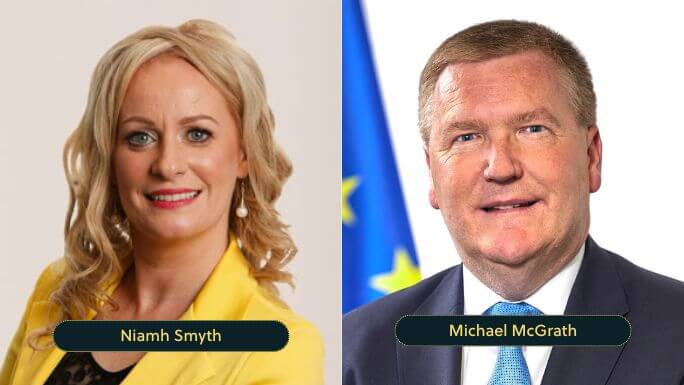
Niamh Smyth, Ireland’s Minister of State for Trade Promotion, Artificial Intelligence and Digital Transformation, struck an optimistic tone. She framed the AI Act as a support for innovation, offering certainty and transparency for industry, and spoke about Ireland’s ambition to be a global AI leader, with a human-centred, ethical approach.
Michael McGrath, EU Justice Commissioner, speaking in a pre-recorded video, was also upbeat and made the point that the EU Act will make it possible for Europe to trust AI, in order for it to thrive and to boost innovation.
Both Smyth and McGrath delivered short addresses, so there wasn’t much detail on how exactly the Act would enable innovation. But the tone was clear: the legislation isn’t just about constraint, it’s about creating clarity so that innovation can flourish.
The work ahead
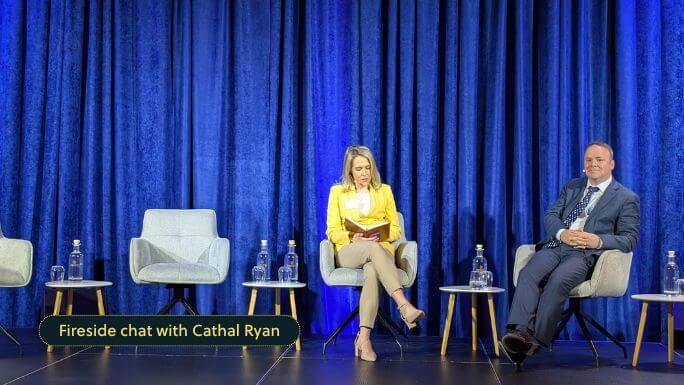
In a fireside chat, Cathal Ryan, Deputy Commissioner at the Data Protection Commission (DPC), gave a pragmatic overview of the AI Act from his perspective.
The DPC is one of nine public authorities charged with protecting fundamental rights in the context of AI, particularly concerning high-risk AI systems.
They’re also one of 8 bodies responsible for supervising the implementation of the AI Act within their respective sector.
He spoke about the scale of the work to be done, and the challenges ahead given the staggering speed that integration was happening at.
He also stressed the need to watch for harms at a societal level, which was an important counterbalance to the generally optimistic tone of the day.
A hint of tension
While the general mood was positive, there were a couple of moments where the increasing tensions between the EU and the US seemed like they might bubble to the surface.
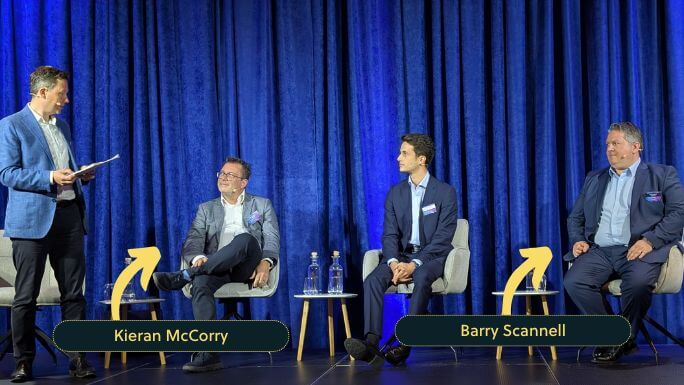
Barry Scannell, one of the event’s organisers, pointed to how GDPR became the global gold standard, but that the EU AI Act isn’t having the same effect.
US voices have been increasingly critical of the EU’s regulatory approach, which has slowed the rollout of some AI models and features in Europe.
The tension Barry hinted at was also referenced by Kieran McCorry from Microsoft, who briefly brought up the ‘current turbulent global situation’, and recommended we look up a speech Brad Smith, vice chair and president of Microsoft gave in Brussels recently.
A volatile moment
If you watch that speech on YouTube, you’ll find a more open acknowledgement of the tension, which Brad Smith calls an ‘unparalleled moment of geopolitical volatility across the Atlantic’.
Smith says ‘business needs to be a bridge across the Atlantic, to be a voice to help enable our governments to find a common path together.’
In the Q&A after that talk he discusses how regulation can provide clarity that avoids the need for decades long court cases to hammer out what the rules are. And clarity allows businesses to adapt.
Which would seem to echo Michael McGrath and Niamh Smyth’s optimistic comments on The AI Act, and how it will foster innovation through clarity and transparency.
Building the cocoon
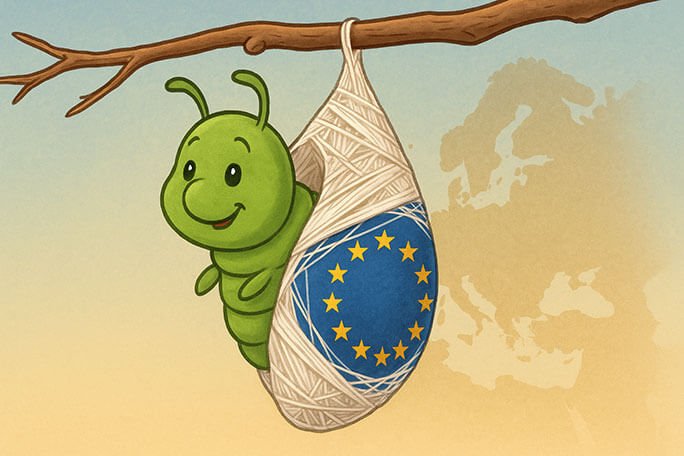
Toward the end of the event, Barry Scannell offered a powerful image: we’re still in the caterpillar stage of AI adoption. The potential is there, but we need to build the cocoon now if we want to transform into a butterfly.
Despite the international tensions, and mindful of the scale of work ahead, I remain confident that the EU AI Act will play a vital role in that cocooning process, giving us the structure we need to transform safely and take flight when we emerge.
In short, the EU AI Act faces challenges, but it could help Europe lead in AI by providing the clarity and trust that both citizens and businesses need.
Where do you stand on the AI Act and the balance between innovation and regulation? I’d love to hear your thoughts.
